
Havn.ai blog
Water Mitigation Bills: What's Reasonable and What to Question
November 3, 2026 · Havn.ai
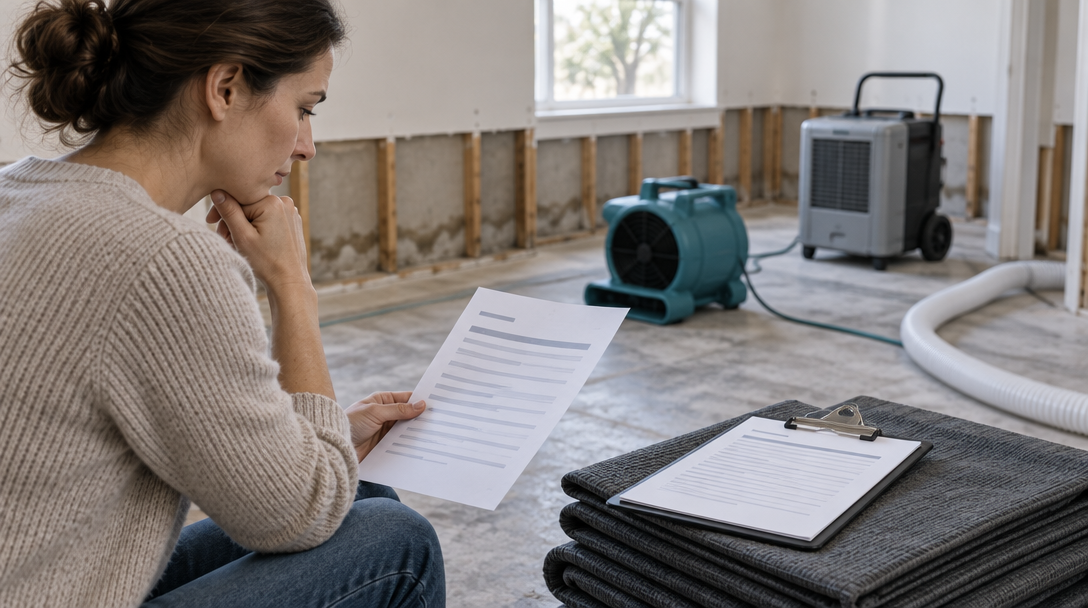
The drying crew arrives within hours, the equipment runs for days, and the invoice lands weeks later with a number nobody explained.
Mitigation is often the first big line in a water claim. It is also the one homeowners question least, because it feels impolite to ask people who just saved your floors. Ask anyway. The bill is part of your claim, and it is checkable.
What mitigation is, and what it is not
Mitigation is emergency work to stop the damage spreading: extracting standing water, drying the structure, containing contamination, removing material that cannot be saved, and monitoring until the structure is dry.
Repair and rebuild come afterwards. Those are priced from a scope of work. Mitigation is priced from time, equipment and labour, which is why the same room can produce very different bills.
What a mitigation invoice is usually made of
- Labour, priced by hours and crew size, sometimes with an after-hours or emergency rate
- Equipment, priced by the day per unit: air movers, dehumidifiers, air scrubbers, heaters, extraction units
- Monitoring visits, where a technician returns to take readings, often charged per visit
- Consumables: antimicrobial, plastic sheeting, tape, filters, PPE, mats
- Removal and disposal, including dumpster fees
- Content handling: packing out, cleaning and storage, if it was requested
Read the invoice with those six categories in mind and it becomes much easier to follow.
What makes a bill reasonable
The defensible drivers are:
- How wet it was, and what kind of material was affected: carpet and insulation dry differently from hardwood and plaster
- How big the affected area was
- How many days drying was needed, evidenced by moisture readings
- What the readings showed, day by day, against a dry standard
- What had to be removed, and why
A bill is well supported when it includes drying logs, daily moisture readings, a moisture map of the affected rooms before and after, and photographs of the equipment actually set up.
A bill is poorly supported when it is a page of totals with no readings behind it.
What to question, politely and in writing
Equipment days beyond the dry standard. Ask for the readings that justified each additional day.
Crew size. Four technicians for a small bathroom is a question, not an accusation.
Monitoring charged per visit, when the readings are the same each time.
Duplicate lines, such as extraction charged twice under different names.
An invoice far above the estimate you signed. Ask what changed and whether you authorised it.
Work not done at your property. Compare the setup photographs with what you saw.
Storage or pack-out you did not agree to. Ask for the authorisation.
The authorisation form you signed
Most mitigation work starts with a form: a work authorisation, a direction to pay, or an assignment of benefits. Those are different documents with different consequences.
- A work authorisation allows the work and obliges you to pay per your agreement.
- A direction to pay tells the insurer to pay the vendor from the settlement, which can leave you exposed if the claim pays less than the bill.
- An assignment of benefits transfers rights in your claim to the vendor, and in some states comes with specific consumer protections.
Find your copy and read it now. If you do not have one, ask for it. You are entitled to know what you agreed to and what protections apply in your state.
Watch the total against your coverage
Mitigation is usually part of the covered water loss, so it is subject to your deductible and any limits that apply. In some policies, specific costs such as mold remediation or temporary repairs sit under separate sub-limits.
Two practical checks:
- Is the total, together with the repair estimate, inside your coverage limits?
- Does any part of the bill fall under a sub-limit, such as mold?
Ask your adjuster to confirm how the mitigation portion is being treated before you accept a large bill as final.
A good process from day one
- Ask for an estimate before work begins, even a rough one, and ask what drives the cost.
- Keep the authorisation you sign, and photograph it.
- Ask for readings as they happen, not at the end. A daily photograph of the meter costs nobody anything and answers the bill later.
- Ask when the dry standard is met, and get it in writing.
- Compare the final invoice to the estimate line by line.
- Send the invoice to your adjuster as part of the claim, and ask for an item-level review of anything you are querying.
Where Havn.ai fits
Havn.ai reads the mitigation invoice alongside your policy, the work authorisation and the adjuster's estimate, and shows you where the documents disagree: equipment days without readings behind them, lines that appear twice, and totals that do not reconcile with the scope.
It works from the documents you upload and does not inspect your home or price the work. It does not negotiate or file for you.
FAQ
Does insurance pay for water mitigation? When the water loss is covered, emergency extraction and drying are usually part of the claim, subject to your deductible and limits.
Can I refuse part of a mitigation bill? You can dispute items and ask for evidence. Whether you are liable depends on what you authorised, so read the form you signed and ask your state insurance department about your protections.
Should I sign an assignment of benefits? Understand it first. It can hand your claim decisions to the vendor. Ask your insurer or a lawyer about the consequences in your state before signing.
What if the crew left equipment for too long? Ask for the drying readings for each day. If the structure met the dry standard earlier, the extra days need an explanation.
Who decides when the house is dry? The mitigation professional determines it against a dry standard, and your adjuster can ask for the readings. Get the date in writing.
This article is general information, not insurance or legal advice. Your policy wording and your adjuster's instructions come first.
This is general information, not legal or insurance advice. Every policy is different, and only your own policy and your state's rules decide your claim. For advice, talk to your adjuster, a licensed public adjuster, or an attorney.